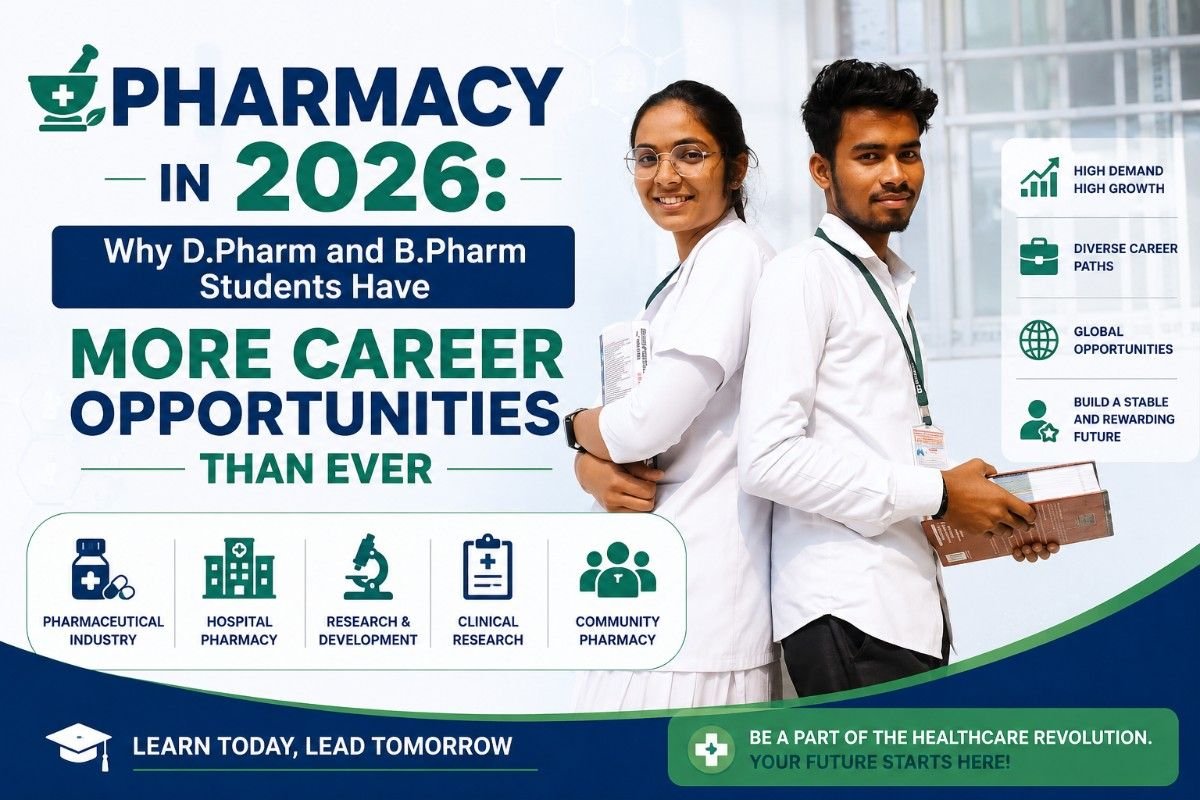
Choosing pharmacy as a career is no longer limited to working behind the counter of a medical store. In 2026, pharmacy is becoming one of the most dynamic and future-ready professions in healthcare. For students after Class 12, especially those exploring professional education in Bihar, D.Pharm and B.Pharm now open doors to careers in hospitals, pharmaceutical companies, quality control, digital health, medicine safety, and regulatory services. Source Source
India’s pharmaceutical sector is also growing at a strong pace. According to IBEF, the Indian pharmaceutical market stood at US$ 55 billion in 2025 and is projected to reach US$ 120–130 billion by 2030. India is also known globally as a major supplier of generic medicines and has a large base of pharmaceutical manufacturing and quality-compliant facilities. This growth is creating wider career opportunities for trained pharmacy students. Source
Why pharmacy is becoming a stronger career choice
The healthcare sector today needs professionals who understand medicines, patient safety, pharmaceutical processes, and healthcare systems. Pharmacy education gives students this foundation through a combination of theory, laboratory work, practical exposure, and professional training. At Gautam Institute of Pharmacy, both D.Pharm and B.Pharm are positioned as career-oriented programmes designed to prepare students for employment and growth in the healthcare sector. Source Source Source
A D.Pharm programme is ideal for students who want to enter the pharmacy profession earlier and build practical knowledge in medicine dispensing, hospital pharmacy, drug store management, and patient guidance. A B.Pharm degree goes deeper into pharmaceutical sciences, formulation, analysis, pharmacology, research, clinical pharmacy, and industrial applications, making it suitable for students who want broader long-term career options. Source Source
New-age opportunities are changing pharmacy education
One of the biggest reasons pharmacy looks more promising in 2026 is that the field is evolving beyond traditional roles. The updated B.Pharm syllabus from the Pharmacy Council of India includes future-ready areas such as Python programming, data analytics, machine learning, AI applications in pharmaceutical sciences, pharmacovigilance, regulatory affairs, innovation, and even Pharma 4.0 concepts. This shows that pharmacy students are now being prepared for a much more modern healthcare and industry ecosystem. Source
This matters because the pharmacy graduate of today is expected to do more than understand medicines. Employers increasingly value students who can work with documentation, data, compliance systems, patient counseling, quality processes, and technology-enabled healthcare environments. That makes pharmacy a smart choice for students who want a career that combines science, healthcare, and professional growth. Source
Career options students should know about
After completing pharmacy education, students can move into several practical and respected roles. These include:
1. Hospital Pharmacist
Hospital pharmacists help manage medicines, review prescriptions, support safe dispensing, and work closely with healthcare teams. This is a good path for students who want to work directly in patient care environments. Source
2. Community Pharmacist or Medical Store Professional
For many students, especially after D.Pharm, community pharmacy remains one of the most accessible and valuable career paths. It offers a direct role in helping patients understand and use medicines safely. Source
3. Quality Assurance and Quality Control
Students who enjoy lab work, standards, and accuracy can build strong careers in QA and QC. India’s large pharmaceutical manufacturing ecosystem continues to create demand in these roles. Source
4. Pharmacovigilance and Drug Safety
Medicine safety is a growing field, and pharmacovigilance is now clearly recognized in updated pharmacy education. Students with attention to detail and interest in patient safety may find this area especially rewarding. Source
5. Regulatory Affairs
As medicines move through approval, compliance, and documentation processes, regulatory knowledge is becoming increasingly important. This is a strong option for students interested in the technical and legal side of pharmaceuticals. Source
6. Digital Health and E-Pharmacy
India’s digital health ecosystem is growing, and pharmacy professionals are expected to be part of technology-enabled healthcare delivery. This creates opportunities in e-pharmacy support, digital prescription workflows, and healthcare platforms. Source
Skills that will matter most in the coming years
Students entering pharmacy today should focus on more than passing exams. The future belongs to pharmacy professionals who can combine:
- strong subject knowledge
- practical lab skills
- communication and patient counseling
- ethical understanding of medicines
- documentation and compliance ability
- digital and analytical skills
These capabilities are already reflected in the direction of modern pharmacy education and in the changing needs of the healthcare and pharmaceutica