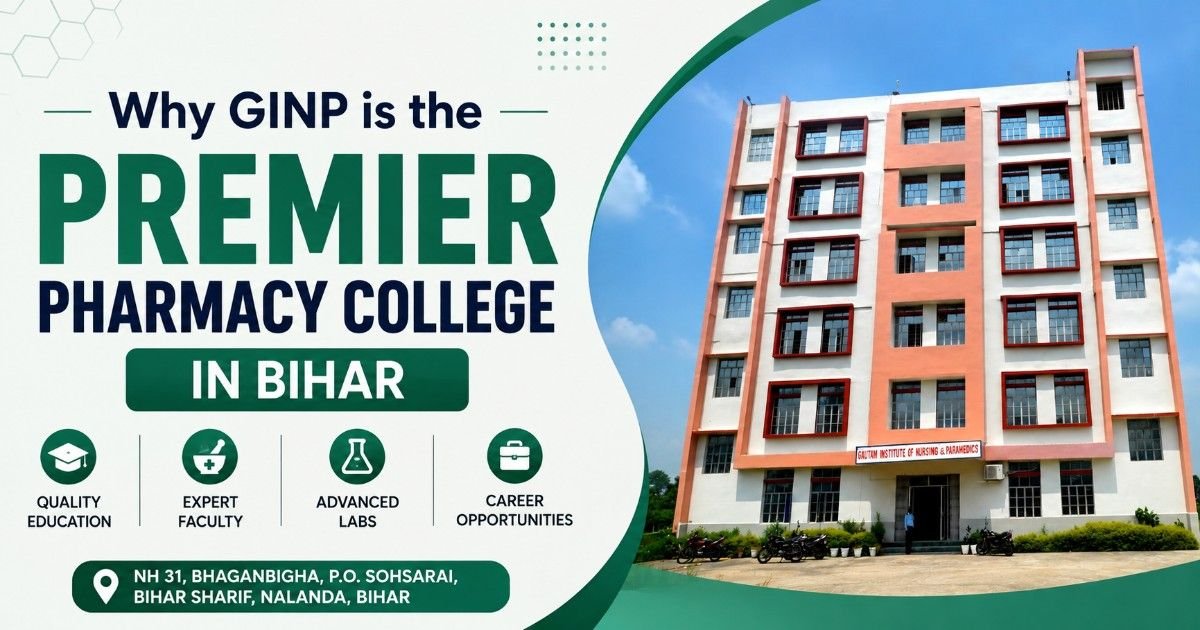

Choosing pharmacy after Class 12 is no longer just about becoming a traditional chemist. Today, pharmacy students in Bihar can build careers across hospitals, pharmaceutical manufacturing, medicine safety, regulatory services, digital health platforms, and public health systems. With India’s pharmaceutical market standing at US$ 55 billion in 2025 and projected to reach US$ 120–130 billion by 2030, the field offers both stability and growth. At the same time, Gautam Institute of Pharmacy offers career-oriented D.Pharm and B.Pharm programmes that prepare students for professional roles in healthcare and pharmaceutical sciences. IBEF Gautam Institute of Pharmacy
For students in Bihar, this is especially important. A pharmacy qualification can create opportunities both within the state and across India, whether you want to work in a hospital, join a pharmaceutical company, serve in public healthcare, or become part of the new digital health ecosystem. The updated Pharmacy Council of India curriculum also shows that pharmacy education is becoming more modern, practical, and future-ready, with subjects like AI, machine learning, pharmacovigilance, regulatory affairs, and innovation. Pharmacy Council of India
1) Community Pharmacist or Retail Pharmacy Owner
One of the most direct career options after pharmacy is working as a community pharmacist or starting your own retail medical store after meeting licensing requirements. This remains one of the most practical pathways for students who want a respected healthcare role close to their community. The D.Pharm course itself is designed to train students to become licensed pharmacy professionals who can manage, prepare, dispense, and advise on medicines in hospitals and pharmacies. The World Health Organization also emphasizes that pharmacists are often the last point of contact before a patient receives an antibiotic, making them essential for patient counseling and safe medicine use. Gautam Institute of Pharmacy World Health Organization
2) Hospital Pharmacist
Hospital pharmacy is another strong career route, especially for students who want to work directly within the healthcare system. Hospital pharmacists support medication dispensing, prescription review, drug storage, and coordination with doctors and nursing staff. Since NHM focuses on universal access to equitable, affordable, and quality healthcare services, pharmacy professionals remain an important part of real healthcare delivery environments. Students trained in practical pharmacy education can fit naturally into hospital-based roles in both private and public institutions. NHM Gautam Institute of Pharmacy
3) Pharmacovigilance Associate
Pharmacovigilance is one of the most promising new-age career options for pharmacy graduates. It focuses on medicine safety, adverse drug reaction reporting, and post-marketing monitoring of drugs. The fact that Pharmacovigilance is now explicitly included in the updated B.Pharm syllabus shows how important this field has become in modern pharmacy practice. Students who enjoy detail-oriented work, documentation, patient safety, and healthcare data can find this path especially rewarding. Pharmacy Council of India
4) Regulatory Affairs Executive
Another excellent option is regulatory affairs, where pharmacy graduates work with drug approvals, compliance documentation, regulatory submissions, and quality standards. This field is ideal for students who are interested in the legal, technical, and compliance side of the pharmaceutical industry. The updated PCI curriculum includes a dedicated focus on Regulatory Affairs, showing that the profession increasingly values graduates who understand how medicines move from development to compliant market access. Pharmacy Council of India
5) Pharmaceutical Manufacturing and Production
India’s pharmaceutical ecosystem includes around 3,000 drug companies and approximately 10,500 manufacturing units, creating large opportunities in production and manufacturing. Students can work in tablet, capsule, syrup, injectable, packaging, and process-related operations depending on their qualification and training. Since India is the world’s largest provider of generic medicines and the third-largest pharmaceutical producer by volume, manufacturing remains one of the biggest employment generators in the sector. IBEF
6) Quality Assurance and Quality Control Analyst
For students who like precision, laboratory work, documentation, and standards, Quality Assurance (QA) and Quality Control (QC) are highly attractive career options. India has the largest number of USFDA-compliant plants outside the US and more than 2,000 WHO-GMP approved facilities, which means quality systems are central to the pharma industry. Pharmacy graduates who understand formulations, testing, compliance, and documentation can build long-term careers in maintaining product quality and safety. IBEF
7) Clinical Research and Drug Development Support
Students who are curious about research, trials, drug data, and scientific documentation can move toward clinical research and drug development support roles. The updated pharmacy curriculum places strong emphasis on research orientation, practical learning, and future-facing technological subjects such as Python, machine learning, data analytics, and AI applications in pharmaceutical sciences. That makes pharmacy graduates more relevant to research-linked functions than ever before. Pharmacy Council of India
8) Digital Health, E-Pharmacy and Health-Tech Roles
Digital health is creating a completely new career space for pharmacy students. Under the Ayushman Bharat Digital Mission, pharmacies are expected to be integrated into India’s digital health ecosystem through facility IDs, ABHA-linked workflows, prescription records, patient identification systems, and invoice uploads against digital prescriptions. This means future pharmacists may work not only in physical pharmacies but also in e-pharmacy support, digital prescription systems, healthcare platforms, telehealth-linked services, and medication-data operations. Ayushman Bharat Digital Mission
9) Pharmaceutical Sales, Product Support and Business Development
Not every pharmacy student wants a lab-based or hospital-based role. Many build successful careers in pharmaceutical sales, product support, market development, and business-facing roles. Because India’s pharma industry is growing rapidly and exports medicines to a large global market, companies need profes